Connected Vehicles
Through V2X (Vehicle-to-Everything) communication, smart vehicles exchange real-time data to enhance road safety, improve traffic management, enable efficient tolling, and increase overall driver convenience.

Through V2X (Vehicle-to-Everything) communication, smart vehicles exchange real-time data to enhance road safety, improve traffic management, enable efficient tolling, and increase overall driver convenience.
Modern vehicles are no longer isolated machines - they are digital, sensor-driven, networked platforms. At the core of th ecosystem are two major communication concepts:
Both concepts rely on GNSS while V2X enables a vehicle via short-range peer-to-peer communication to directly interact with its immediate environment - including other vehicles, infrastructure, and pedestrians - primarily to support real-time safety and local traffic efficiency. V2N, in contrast, connects the vehicle to the mobile network (4G/5G/6G) to access cloud services, remote diagnostics, and continuous data intelligence. While V2X focuses on ultralow latency, local, safety critical interactions, V2N delivers high bandwidth, wide area connectivity for navigation, updates, and fleet management. Due to requisite physical roadside units, V2X can operate even without cellular coverage, whereas V2N depends entirely on network availability and quality. V2N further promotes flexible implementation through point-based use cases via virtual RSU or trip-based use cases through continuous connectivity. Together, both technologies form a complementary system that enables fully connected, data-driven, and increasingly automated mobility.
For road authorities and national transport departments planning their strategic futures, connected vehicle technology is one of the most important innovations to incorporate. Connected Vehicles represent a family of enabling technologies that support both traffic management and tolling, and form a key building block of modern, data-driven transportation systems.
These connected car capabilities enable vehicles to exchange information about collisions, brake events, pedestrians and cyclists, helping drivers and passengers make driving decisions more safely and effectively. Combined with sensors and cameras, modern vehicle connectivity supports a growing range of innovative products and services that improve mobility for greater safety and convenience.
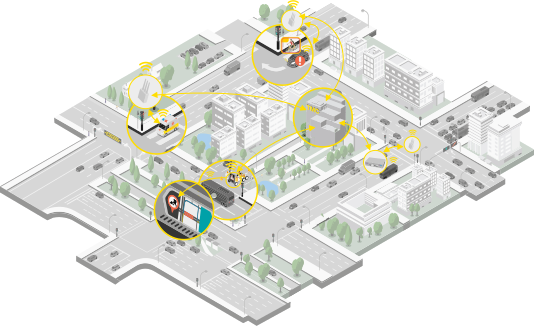
In traffic management, connected vehicle systems combine real-time traffic information, vehicle data and incident reports to proactively warn drivers about potential hazards ahead. They help prevent accidents, improve safety and efficiency, and support better driving decisions. Moreover, it is also possible to give priority to emergency services and public transport, optimize traffic signals at intersections, and significantly ease traffic flow in both urban and interurban environments.
Depending on the legislative framework in place, the same connectivity and communication technologies can also be leveraged for tolling applications.
By linking Connected Vehicles with advanced data collection and processing platforms at the network edge and in the cloud, Kapsch TrafficCom uses CVs to deliver real-time traffic management solutions and automated, efficient and dynamic toll collection solutions.

In urban environments, connected vehicles make the roads safer, greener, and less congested. With them, city authorities can dynamically manage congestion to optimize the flow of traffic as road conditions change.
They are, for example, a key enabler of priority and preemption systems. These use the data provided by CVs to optimize the flow of traffic through traffic lights by adjusting their timings, giving priority to public transport or emergency vehicles. They can also give information to drivers which is designed to make their journey faster and smoother. This can include guidance on the optimal speed to travel to reach lights when they turn green, and warnings of signal violations.

Between cities, interurban CV use cases concentrate on timely in-vehicle information to drivers to avoid congestion, incidents like e.g. work zones or approaching emergency vehicles and other conditions effecting their route. Even motorists without C-ITS capabilities benefit from smart highways equipped with advanced sensors and communication systems that broadcast real-time updates on traffic flow, speed regulations, and potential hazards. Such infrastructure contributes to safer journeys, smoother traffic operations, and improved network efficiency. Over time, these systems also support more proactive traffic management and enhanced traveler experience.

As connectivity becomes more widely embedded in vehicles and roadside infrastructure, a substantial and fast-expanding opportunity is emerging to integrate tolling functions directly into the C-ITS ecosystem. These approaches significantly streamline system deployment and configuration, ultimately reducing infrastructure complexity and associated costs. By leveraging existing communication frameworks - including both direct V2X interactions and Vehicle‑to‑Network (V2N) links to cellular networks and cloud services - authorities can accelerate implementation while enhancing operational flexibility. While the EU Tolling Interoperability Directive currently excludes the use of ITS-G5 technology for tolling applications, the U.S. Highway Trust Fund - responsible for financing highway infrastructure - is projected to face a funding shortfall approaching $280 billion by 2035. This gap is intensifying the search for sustainable, technology-driven road-usage charging models. Kapsch TrafficCom stands out as the only provider in North America offering both radio frequency-based (RFID) and V2X/V2N tolling technologies. This unique capability positions the company at the forefront of the shift toward connected and increasingly autonomous mobility.

We are moving past the theoretical phase of C-V2X into the operational reality. This deployment establishes the digital infrastructure necessary to treat the vehicle itself as the tag. By integrating these advanced data streams into our existing roadside and operational back office systems, we are delivering the production-grade platform that agencies need to confidently step into the next era of mobility.
JB Kendrick, President of Kapsch TrafficCom North America.

Connected Vehicles combine the fundamental elements of all mobility solutions – data and communications. This is an extraordinarily powerful combination, which makes it possible to imagine a converged and unified ecosystem which breaks down the boundaries between traffic management and tolling.
The transition is already underway. Connected vehicle technology is enhancing existing traffic and tolling solutions, enabling more agile, scalable and cost-efficient digital infrastructures that rely on less physical hardware. Data is transmitted securely from vehicles to the cloud, supporting real-time analytics and predictive insights.
The direction of travel is clear: a fully integrated, data-driven digital mobility infrastructure. On this journey, authorities must manage legacy vehicle systems while embracing emerging C-ITS, V2X and autonomous driving technologies.
Kapsch TrafficCom is one of very few companies with proven experience in C-ITS deployments across both traffic and tolling – and one of even fewer able to integrate traffic management, tolling and connected vehicle solutions end-to-end. This proven track record, combined with a clear strategic focus, makes Kapsch TrafficCom a compelling partner for agencies navigating the future of connected and automated transportation.
Traditional traffic infrastructure projects often rely on extensive physical installations and long implementation cycles. Connected vehicle technology facilitates the evolution towards digital infrastructure resulting in increased intelligence from software, data platforms and connectivity, while reducing dependence on roadside hardware.
This software-centric approach enables authorities to introduce new use cases incrementally, adapt solutions to changing road conditions and scale services as demand grows. As a result, connected vehicle solutions reduce complexity, shorten deployment timelines and significantly improve time to market for innovative traffic and mobility services.
Kapsch TrafficCom’s technology stack integrates connected vehicles with our traffic management and tolling portfolios. We support both short-range (5.9 GHz) and network-based communication solutions, making our approach communications-agnostic.
Our portfolio includes ITS-G5, C-V2X and Dual-Mode roadside units. These provide short range, ultra-low latency wireless communications between infrastructure and vehicles. Our open interface and modular architecture enable a scalable and future proof RIS-9x60 platform.
Where no physical roadside units are available, our virtual roadside platform enables two-way communications between connected vehicles and our traffic management solutions. This expands the coverage of cooperative ITS systems and enables secure and reliable messages to be exchanged using dedicated PKI/SCMS services.
Our portfolio includes ITS-G5, C-V2X and Dual-Mode onboard units (OBU) which are incrementally integrated in a vehicle’s in-vehicle system.
We provide a cloud-based or on-premises modular platform for managing and monitoring the connected vehicle environment and empowering road authorities to communicate directly with connected road users. An intuitive visualization of key information enables road managers to monitor real-time events and create standardized ITS messages. This creates a fully interoperable intelligent transport system.
Leveraging shared V2X/V2N infrastructure, agencies can harmonize traffic management and tolling into a single, adaptive system -accelerating deployment, cutting OPEX, and improving traveler outcomes.
New and innovative ways to interact with customers while traffic management applications smooth the journey for drivers through towns and across the country and tolling applications are completely seamless.
Harmonizing all existing and future methods of vehicle detection
Consistent KPIs measured at the transaction level regardless of detection method
Reduction of total cost of operations and new technology deployment timelines.