Do you want to switch the language?
A person using a mobile phone navigation inside a car.

Location based charging

Kapsch’s location based charging technologies deliver the next generation of charge solutions for national, urban and inter-urban road networks and highways. The solution is vehicle-centric and designed to support different charging and tolling schemes across a wide range of operating settings.

The rapid increase in vehicle connectivity means that more data is being generated which can be used for the road charging and tolling. First with 2G, and especially now with the introduction of 5G, the building blocks for the next generation of road pricing solutions based on vehicle location data are all in place.  

This is significant because authorities around the world are facing increasing challenges caused by growing traffic volumes. As the number of kilometres and miles driven each year continues to rise over time, congestion, road surface wear and air quality issues are getting steadily worse. Location based charging solutions enables authorities to respond with targeted charging models that reflect time, location and actual road usage. They can be deployed on any size of road network without spending a fortune in road infrastructure.    

Satellite-based GNSS technologies provide solutions for different customer needs. For traditional toll operators, satellite charging supports migration from gantry-based systems to a more cost-efficient and flexible base infrastructure. For cities, location based charging helps reduce congestion and improve air quality by enabling specific charges in defined zones or time windows. For nation states, solutions support Road User Charging models or nationwide truck tolling schemes. 

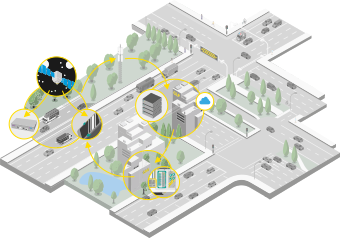
A map of a city using location based charging

Kapsch TrafficCom’s location-based charging portfolio 

Kapsch TrafficCom is one of the world’s most experienced providers of location-based tolling solutions, with a unique set of technology, service and business capabilities.  

GNSS-based tolling

gnss icon

 The next generation Kapsch satellite tolling solution delivers nationwide schemes to collect tolls over dedicated road networks.  Because it uses satellite positioning data, rather than an extensive roadside infrastructure, the solution is extremely economical. It works with both dedicated and existing aftermarket and in-vehicle hardware to deliver a future proof approach to truck and light vehicle tolling. 

Road User Charging 

ruc icon

The Kapsch TrafficCom Road User charging (RUC) solution is a versatile tool for addressing the fuel tax deficits that are being caused by the growth in hybrid, electric and high efficiency vehicles. It can be configured to apply different prices according to numerous criteria such as time of day, location, vehicle type and size and emissions class. 

Tolling as a Service (TaaS) and components 

Kapsch TrafficCom supplies all the enabling hardware and software components that make it possible to provide tolling services. Crucially, we are also able to draw on our unique experience of supporting numerous TSPs and EETS providers to ensure that our customers can successfully meet the evolving challenges of certification. 

The core of our component solution, our OBU is provided complete with all embedded firmware, supporting software and tools such as proxy and asset management. It is fully configurable to conform to the different technical and certification requirements of each individual toll domain. 

Location-Based Data Analytics for Smarter Roads 

Location based charging doesn’t just enable charge collection – it generates rich location and vehicle data that authorities can use to explore traffic patterns, identify congestion hotspots, and optimize road networks. 

By analyzing aggregated in-vehicle and smartphone data, cities can improve road planning, adjust time-based charges, and develop targeted policies for specific vehicle types or electric fleets. This data-driven base allows road authorities to share insights across departments and support smarter mobility strategies without additional infrastructure investments. 

A modular architecture or a complete end-to-end solution  

Unlike other tolling companies, Kapsch TrafficCom can provide each of the unique building blocks to deliver a complete end-to-end GNSS-based tolling scheme. By adopting a modular approach, we can deploy individual building blocks including components for tolling services, enforcement, and map matching and rating. 

  • Geo Location Platform (GLP) 

    The key building block of our end-to-end modular tolling system is the Geolocation Platform (GLP). This is the core data processing platform that takes geolocation data from OBUs, telematics devices, smartphones, or connected vehicles, and turns it into useful information that can be used for tolling purposes.  
    A key feature of the Kapsch TrafficCom GLP is its ability close gaps in the geolocation data. For example, if a car or truck goes through a tunnel, or travels through a long, narrow and deep valley, the vehicle will inevitably lose sight of the satellites. In such circumstances, the GLP will close these data gaps using a series of smart algorithms which consider variables such as vehicle speed, direction and map-based contexts to define the most probable route that the vehicle could have taken. The GLP can implement charging logic based on both section and ‘true distance-based’ forms of calculation or even using geofences in cases where exiting gantries with RF and/or video technologies are used alongside GNSS-based detection.   

  • Asset management platform 

    The OBU communicates with an asset management platform which enables toll operators to manage devices remotely. This asset management capability enables operators to configure, update, and communicate with each individual OBU.  

  • Enforcement system 

    All toll schemes require a secondary means of enforcing tolls. Some trucks, for example, will try to avoid tolls by driving without an OBU, or with the device turned off. The Kapsch  TrafficCom enforcement system addresses this challenge. It consists of Automatic Number Plate Recognition (ANPR) cameras (optionally augmented with vehicle classification and DSRC communication), either located at fixed spots along the road network, or attached to the roofs of moving vehicles. The enforcement system identifies the trucks with these images and identifies any that are travelling without the necessary tolling apparatus in place.  

  • Commercial back office  

    The final part of Kapsch  TrafficCom’s modular, end-to-end GNSS tolling solution is the commercial back office. This is responsible for billing and invoicing. It also handles exception lists such as diplomatic vehicles, or emergency service vehicles.  
    The final part of Kapsch TrafficCom’s modular, end-to-end GNSS tolling solution is the commercial back office. This is responsible for billing and invoicing. It also handles exception lists such as diplomatic vehicles, or emergency service vehicles.  

  • Cyber-security and privacy 

    Because a satellite solution is based upon user consent within a legislative framework, it is critical that tolling authorities can guarantee the integrity of the data. GDPR and EDPB guidelines mandate that there needs to be a legitimate and lawful purpose for collecting and processing the data. The guidelines can extend to how long the data can be held for and, perhaps, even where the data could be stored.  

    Kapsch TrafficCom has unique understanding and appreciation of the challenges of cyber-security and privacy. For example, should a tolling authority want to extend the privacy of the solution, they can exclude data about where a trip starts and stops. Information can be stored solely to enable users to verify its accuracy in the event of an appeal. Moreover, anonymized data can be captured, with user consent, to enable city authorities to understand where, and at what times, traffic congestion occurs. 

Our solution works with all sources of geolocation data

Kapsch TrafficCom’s modular, end-to-end GNSS tolling solution is completely agnostic about the source of the geolocation data that it requires.  

  • On Board Units (OBUs) 

    If a toll operator is considering a new scheme for monitoring and charging for heavy goods vehicles, we can provide a dedicated onboard unit (OBU) for each vehicle, together with its associated asset management and proxy software. Such solutions are far cheaper to create than more traditional tolling solutions because the physical gantry and roadside infrastructure do not have to be constructed. 

  • Existing telematics devices  

    Our end-to-end solutions can take geolocation data generated by any device which already exists in a vehicle (such as those installed for fleet management and tracking purposes). 

  • TollAssist App by Kapsch TrafficCom  

    Compared to dedicated devices smartphones represent a lower cost and faster to deploy alternative and can be used for a variety of  road tolling  and road user charging schemes.TollAssist replaces a physical onboard unit by collecting GNSS positions and acting as the primary user interface. TollAssist sends GNSS positions at defined intervals to the Geo Location Platform, where a transaction is made and also links directly to  the commercial back office, enabling full transaction payments and broader account management functionality. It is particularly suitable for toll operators wishing to cost-effectively augment an existing gantry-based system and those wishing to extend GNSS-based charges to individual users and light vehicles

  • Connected Vehicles 

    Almost all modern vehicles generate and communicate geolocation data which can be used by Kapsch TrafficCom’s end-to-end tolling solutions.

  • Economical and future proof 

    Less infrastructure is needed than for more traditional radio frequency or ANPR-based approaches. The solution is also scalable much faster and more flexibly than existing solutions. New road sections, for example, can be added, or classifications changed, without the need for extensive additional roadside equipment.  

  • Highly flexible  

    With our solutions, how distance-based tolls are calculated and charged is entirely up to the road authority. Authorities can choose, adapt, and refine based on their individual circumstances and priorities.  

  • Support of all tolling types 

    The Kapsch TrafficCom solution supports both real distance driven and segment-based tolls using data from any source. These include dedicated tolling and European Electronic Toll Service (EETS) devices, smartphones, aftermarket fleet telematics, track and trace units, and connected vehicles.  

Contact us